Insights
Insights
How Job Architecture drives compensation strategy

What is Job Architecture?
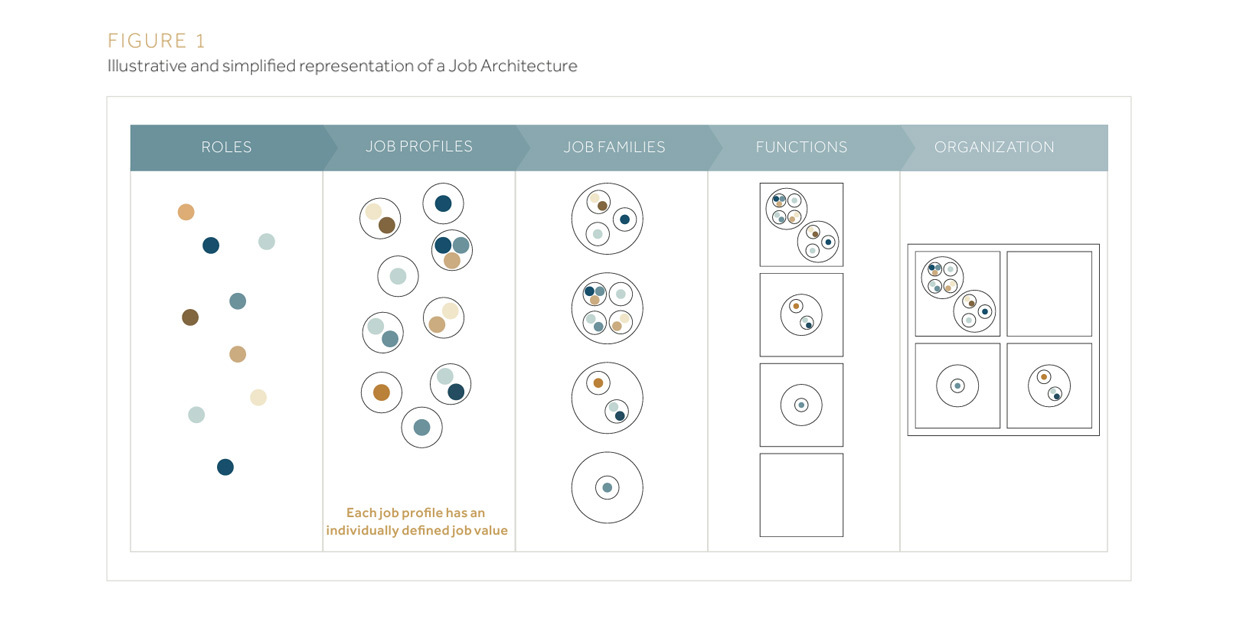
Job Architecture is the organizational framework that defines all job profiles within an organization, what they contribute and how they fit within a robust job structure. In short, it creates clarity by defining roles, job profiles, job families, and functions as well as evaluating jobs based on their “job value” (see figure 1).
This establishes an objective and consistent foundation for the strategic analysis and proactive management of the workforce, addressing both current and future needs.
Evolving markets, new technologies, and shifting customer demands represent only a fraction of the forces that illustrate why organizations must continuously adapt and evolve. In many cases, however, as organizations scale, transform, or adjust their strategies, the rapid and complex nature of change requires management to expand its role in organizational design.
This challenge is often compounded by organically grown roles and structures that lack flexibility, consistency, and scalability. At this point, Job Architecture becomes a critical cornerstone of future-proofing and transformation, elevating it from an HR activity to a core executive leadership mandate. Its ultimate purpose is to enable proactive organizational steering rather than reactive adaptation.
What is the value of Job Architecture for the organization?
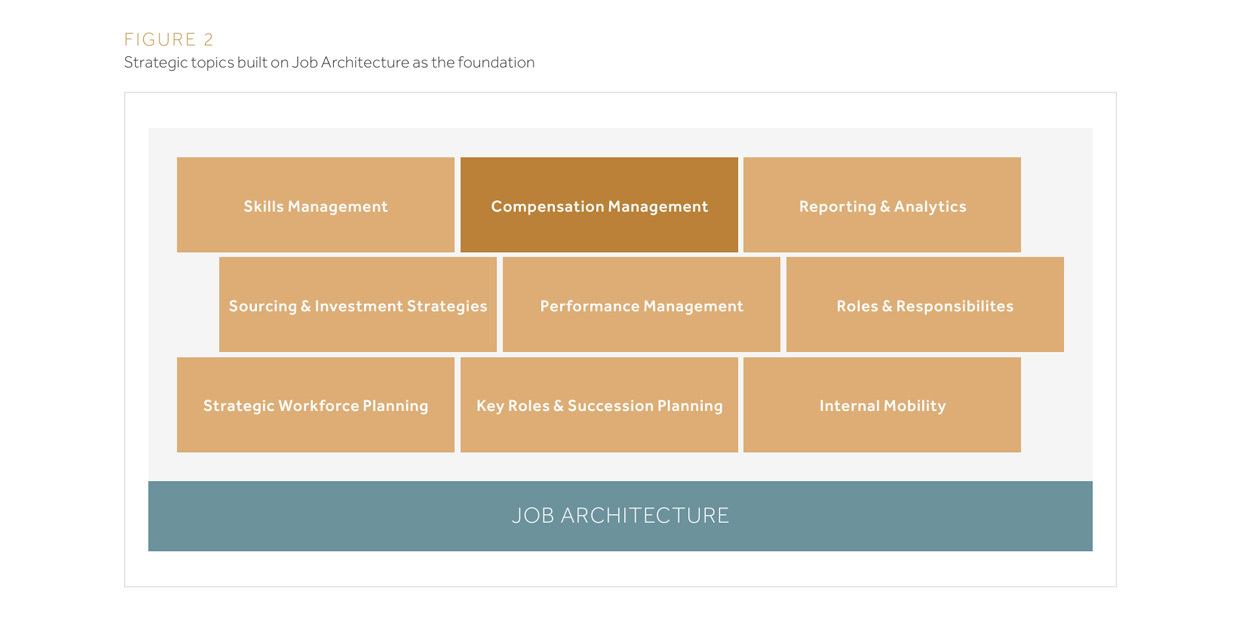
Building on the conceptual framework outlined above, Job Architecture extends far beyond a single strategic domain. It serves as the foundation, comparable to the structural footing of a wall, enabling executive leadership to address critical forward-looking questions, including:
- Are our roles and jobs aligned with our future business model?
- Are we structurally set up to scale profitably?
- Will we remain competitive in the years ahead?
- Are we compensating jobs in line with the value they create?
- Are we funding strategy or maintaining complexity?
Following this analogy, Job Architecture comprises a set of strategic elements that are designed and interconnected like building blocks (see figure 2).
These building blocks can only function as intended when the foundation, Job Architecture, is robust and firmly in place. Among the various building blocks built on this foundation, one stands out as particularly closely linked and as one of its most tangible applications: Compensation Management.
From an executive leadership perspective, compensation typically constitutes one of the largest cost drivers in most organizations. Job Architecture therefore provides a critical foundation for steering people costs, supporting that compensation reflects a deliberate and appropriate exchange between organizational value and financial investment. From an employee perspective, Job Architecture provides structural clarity and forms the basis for market-aligned, transparent, and understandable compensation systems.