Insights
Insights
Board Shareholding Study 2026

Non-Executive Director Shareholding Global Market Practices and Governance Considerations
How high is the shareholding of Non-Executive Directors (NEDs) around the world? To what extent is this supported by equity-based fees or minimum share ownership requirements?
An analysis of NED shareholdings at 491 companies, covering 4,145 non-executive directors in selected jurisdictions, shows no unified practice. There are meaningful differences between markets.
Across the sample, the median company-level average NED shareholdings is approximately USD 0.4 million. However, levels vary widely, from approximately USD 4.3 million in the USA and USD 1.5 million in Switzerland to USD 0.24 million in the UK and approximately USD 0.02 million in South Korea.
Whether NEDs are required to own shares or receive shares as part of their remuneration is equally varied. In the reviewed sample, 53% of companies have a minimum share ownership requirement and around 46% use equity-based NED fees, but the practices and combinations of practices used differ materially by market.
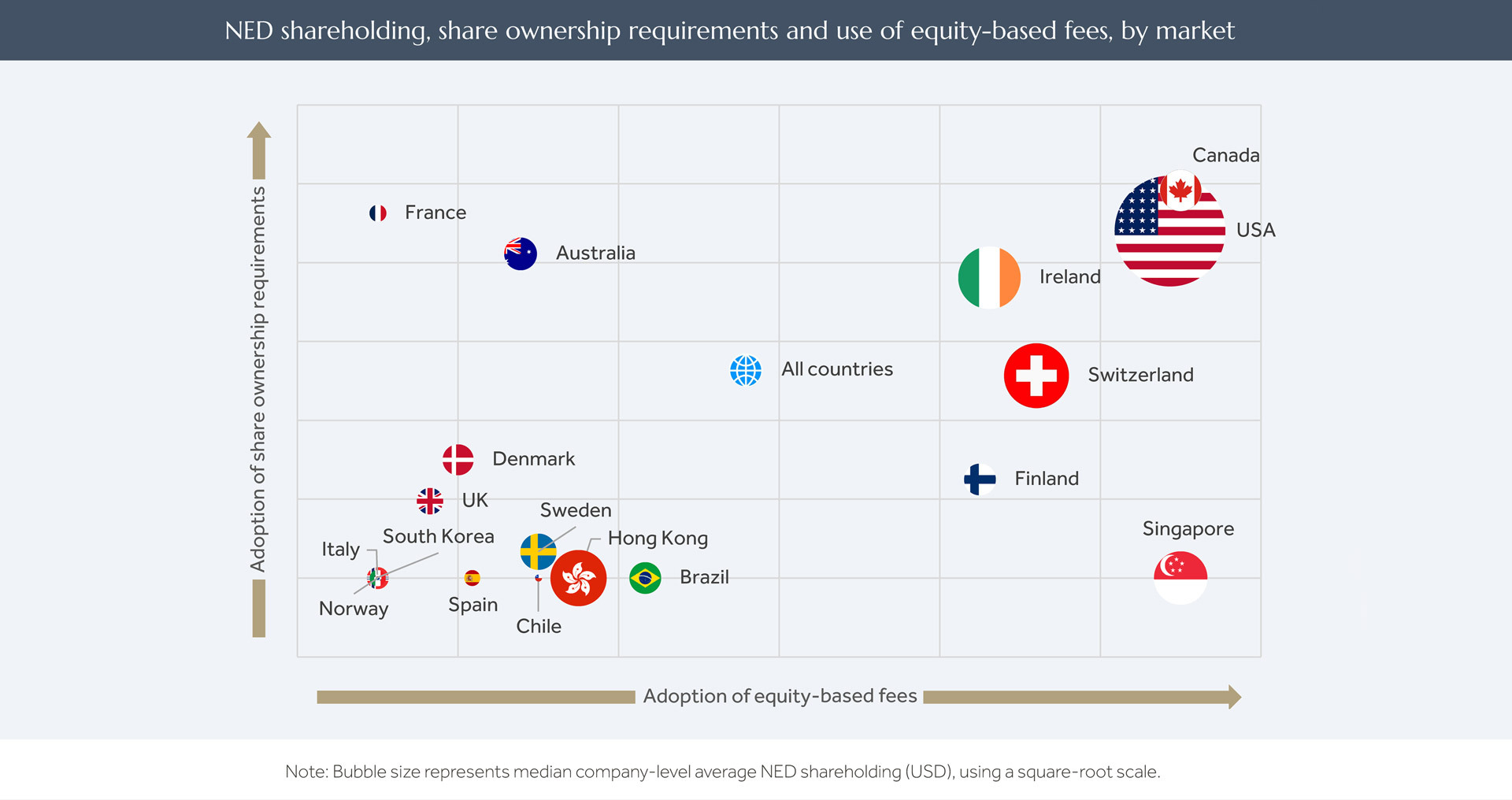
Australia and Finland illustrate the contrast particularly well. Their median NED shareholdings are similar, but the mechanisms associated with these shareholdings are very different. In Australia, minimum share ownership requirements cover more than 80% of sampled companies, while only around 18% use equity-based NED fees. In Finland, approximately three-quarters of companies use equity-based NED fees, while minimum share ownership requirements are considerably less common. These differences likely reflect variations in local market expectations, fee practices and quantum, and governance guidelines.
At an aggregate level, NED shareholdings are associated with the use of equity-based NED fees and minimum share ownership requirements, although the strength of the association differs between the two practices. Companies using equity-based NED fees show substantially higher median shareholdings, whereas the incremental difference associated with share ownership requirements is considerably smaller. These patterns are not consistent across individual markets and may also reflect factors such as company size, accumulated shareholdings over time, and personal investment. It is therefore important to consider the broader context in which NED shareholding develops.
The governance frameworks reviewed generally do not treat NED shareholding or fixed, non-performance-linked equity-based NED fees as inherently incompatible with director independence. Greater sensitivity applies where remuneration is performance-linked or where the scale or nature of a NED’s shareholding may raise concerns regarding independence or reputation.
For Boards, the practical questions therefore extend beyond whether NEDs should hold shares, receive shares as part of their remuneration, or be subject to minimum share ownership requirements. More relevant considerations are the appropriate level of shareholding in the relevant market, how that shareholding is expected to build over time, and whether the nature of the resulting ownership arrangement remains consistent with applicable independence expectations.